- Legal Education and Access Portal

The Legal Status of Student Unions in Pakistan
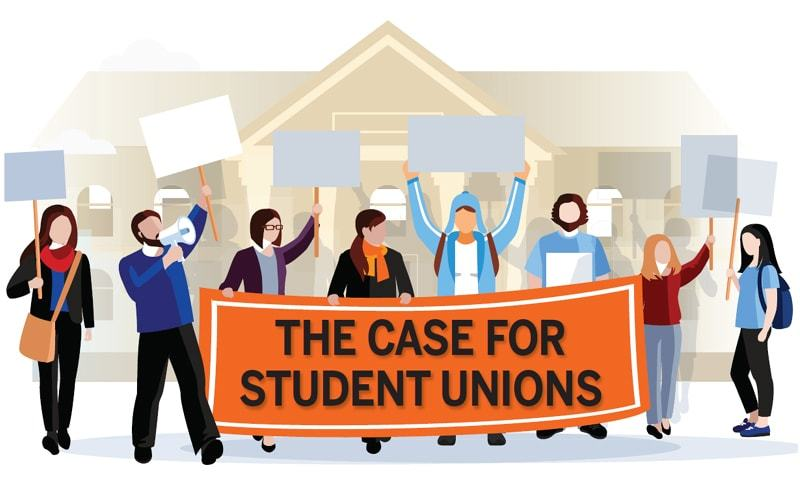
Student unions have historically played a vital role in shaping political consciousness, leadership skills and democratic values among young people. In Pakistan, however the status of student unions occupies a complex and somewhat ambiguous position within the country’s legal and institutional framework. Student unions today exist in a highly restricted and uncertain environment, but there are some places in society as full of energy, ideas and unfurnished questions as a university campus. It is a place where young people arrive not only to earn degrees, but also to test beliefs, challenge authority and learn how society actually works beyond textbooks. In many countries, student unions are the formal channel through which this energy is organized. As historian Ian Talbot notes in Pakistan: A Modern History, student politics played an important role in shaping political leadership and mobilization in Pakistan’s early decades
They act like a collective voice of students, a bridge between administration and the student body, and sometimes even as a training ground for future political and social leaders. In Pakistan, however student unions occupy a strange and uneasy position, they exist in history, in memory and in debate but their legal status remains unclear, inconsistent and deeply contested. To understand the present legal status of student unions, it is important to look brief at history. In the early decades of Pakistan, student unions were active and influential. Student organizations such as Islami jamiat-e-Talaba (IJT), the People’s Students Federation (PSF) and others were deeply involved in political movements, protests against authoritarian regimes, and debates over national issues.
Many national leaders began their political careers in student politics. These unions provided a training ground for leadership, negotiation, public speaking and organization. However, over time student politics became increasingly violent and fractionized, especially during the 1980s and 1990s. This period damages the reputation of student unions and gave rise to the belief that student politics creates instability, disrupts academics life, and threatens campus security. At the heart of this issue lies a paradox. Scholars studying campus politics, such as Tariq Rahman, have also observed that increasing violence and factional conflict in the late twentieth century significantly damaged the reputation of student unions.
The constitution of Pakistan guarantees freedom of association and freedom of expression, subject to reasonable restrictions. From a legal perspective, Article 17 of the Constitution of the Islamic Republic of Pakistan (1973) guarantees citizens the right to form associations, subject to reasonable restrictions imposed by law. Students like all citizens, should be able to form associations to represent their interests. They are neither fully protected nor completely abolished. Instead they exist in a legal and administrative grey zone. This grey zone did not appear overnight. It is the result of history, politics, and fear, fear of disorder, fear of violence, fear of politicization, and fear of losing control over campuses. In early decades of Pakistan, student unions were active and influential. Overtime, however, student politics became increasingly entangled with mainstream political parties.
What is important to understand is that these restrictions were often not introduced through a single, clear, and comprehensive law passed by parliament. Instead, they came through executive orders, administrative decisions, and university regulations. This means that, student unions were not permanently and uniformly banned in a strict sense. Rather, they were pushed into a space where their existence depended on policy choices, security concerns, and institutional preferences. This is what makes the status of student unions in Pakistan so unusual and so interesting. When something exists in grey area, it tends to become fragile and inconsistent. Students are not quite sure what they are allowed to do. Administrations have wide discretion to permit or restrict activities.
Restrictions on student unions have often been justified by pointing to past experiences of violence and disruption. This is a real part of history and cannot be ignored. Campuses are educational spaces, and their primary function is academics. If political activity turns classroom into battlegrounds, the purpose of education is undermined. However, regulation is not the same thing as legal uncertainty. A regulated system is one where the rules are clear, known in advance and applied consistently. An uncertain system is one where the rules change, remain unwritten or depend heavily on discretion.
The current legal status of student unions in Pakistan looks more like the second than the first. This does not necessarily mean that authorities intend to suppress students, but it does mean that the relationship between law, policy and practice is not clearly defined. The current legal status of student unions in Pakistan reflects this tension without fully resolving it. The constitution provides broad rights. The administration provides practical limits. In the end, the story of student unions in Pakistan is not a story of simple permission or simple prohibition. It is a story of uncertainty, negotiation and compromise between different priorities, i.e. education, security, freedom, and order.
The law instead of offering a clear answer has become part of this negotiation leaving space for interpretation and discretion. Perhaps the most striking thing about the legal status of student unions in Pakistan is that it tells us less about student unions themselves and more about the state and institutions manage participation. It shows a system that is cautious, shaped by passed experiences and hesitant to commit either way. Student unions are neither fully inside the legal system nor fully outside it.
They exist on the edge recognized in principle and limited in practice. It is not just about students, it is about law, authority, history and the ongoing question of how society choses to balance voice and control. In Pakistan, the legal status of student unions remains one of the clearest examples of unfinished, unresolved and deeply tied to the country’s broader political and institutional journey.
Bibliography
Legislation
Constitution of the Islamic Republic of Pakistan 1973.
Books
Talbot I, Pakistan: A Modern History (Hurst & Company 1998).
Journal Articles
Rahman T, ‘Student Politics in Pakistan’ (2007) 44 Economic and Political Weekly.
The opinions expressed in this article are the author's own and do not reflect the views of LEAP Pakistan or Pakistan College of Law.