- Legal Education and Access Portal

Rethinking Child Recruitment Under International Criminal Law
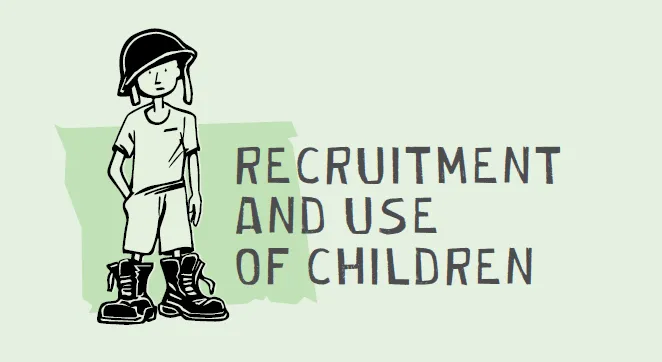
“War violates every right of a child – the right to life, the right to be with family and community, the right to health, the right to the development of the personality and the right to be nurtured and protected,” Graça Machel wrote in her 1996 report to the UN General Assembly on the impact of armed conflict on children. Three decades on, international criminal law has built increasingly precise tools for identifying a child soldier, but those tools were built around a single image, a combatant under 15, that no longer matches how children are actually drawn into violence.
The recruitment of children as soldiers and their involvement in armed conflicts has been a concern for the global community for a long time. Under international criminal law, this is regarded as a war crime. In the context of an international or internal armed conflict, the Rome Statute’s war crime of child recruitment is set out in Articles 8(2)(b)(xxvi) and 8(2)(e)(vii). It criminalises the conscription, recruitment, or use of children younger than 15 years of age. Two structural gaps sit underneath that definition and both need rethinking.
The first is a gap of age. In 2023, close to ninety per cent of children verified as recruited and used in conflict were boys. By 2024, just over a third were girls, according to the United Nations (UN) Secretary-General’s most recent report on children and armed conflict. They are recruited to cook, carry supplies, guard positions, and in a number of cases are held as sexual property by the men who abducted them.
A child between age 15 to 17 years held by an armed group and recruited into domestic servitude or sexual slavery occupies a genuine legal void: too old to count as a victim of a war crime and under Rome Statute Article 26, too young for the Court to prosecute if the child carries out violence. This is a statutory loophole that allows recruiters to exploit the children.
The second is a gap of classification. The war crime only applies inside an armed conflict. The coercive recruitment happening outside that frame is classified as gang violence, organised crime, or unrest that never crosses the threshold into conflict. The war crime provisions cannot reach it at all, regardless of the age of the children involved.
Beyond the Functional Test
The idea that only combat counts as active participation in hostilities did not survive contact with the jurisprudence of the Special Court for Sierra Leone (SCSL). In Prosecutor v Brima, Kamara and Kanu, the AFRC Trial Chamber held that active participation covers “any labour or support which gives effect to, or helps maintain, operations in a conflict,” including carrying loads, acquiring food or ammunition, acting as decoys, and manning checkpoints. The Chamber’s reasoning was purposive rather than literal: it asked whether an activity sustains an armed group’s capacity to fight, not whether it involves direct violence, a test broad enough to reach roles with no proximity to combat at all, and one that better reflects how support and combat functions are often interchangeable, and gendered, within non-state armed groups. In Prosecutor v Taylor, Trial Chamber II went further still, finding that guarding a diamond mine for an armed group also constituted active participation.
Sudan’s own 2024 data demonstrate its significance. There were 25 children verified by the United Nations as having been recruited and used by parties to the conflict, all boys. During the same time, the UN confirmed 74 child sexual violence cases, which included 73 females, plus 57 child abductions. The Rapid Support Forces were responsible for 54 of the 74 sexual violence cases and 56 of the 57 abductions. The same loophole is also what makes it possible for the girls in Sudan to be counted where the recruitment offence cannot reach them. One way to close that gap is the broad reading of SCSL’s functional test. It would cover domestic servitude and sexual slavery, but it needs the court to stretch a provision built around combat. The provisions of Crimes against humanity, however, naturally cover such abuses. For example, enslavement under Article 7(1)(c) is defined to include forced domestic labour and reducing a person to servile status, and sexual slavery is listed separately under Article 7(1)(g). Neither carries an age threshold or requires an armed conflict.
From “Children with Arms” to “Children Affected by Arms”
The clearest indicator that the law can move in this direction came from the International Criminal Court (ICC) itself. The Office of the Prosecutor (OTP) had charges of rape and sexual slavery added to its case against Bosco Ntaganda in 2013 for crimes by his own subordinates against child soldiers in his militia. In 2017, the defence’s challenge was rejected by the Appeals Chamber. The Trial Chamber VI sentenced him to thirty years in 2019 and the Appeals Chamber upheld the ruling in 2021. That was the result of a conscious institutional change of emphasis, an address in 2012 announcing a change from children with arms to children affected by arms that would be followed by the OTP’s 2016 Policy on Children, which says prosecutors must pursue all charges the evidence warranted. Ntaganda and the 2016 Policy show the institutional appetite to move past the combat paradigm already exists inside the Court. What is missing is applying that same appetite to the age group the Statute currently ignores altogether.
A 16 Year Old Is Neither Victim Nor Defendant
The war crime of child recruitment protects only children under 15, while Article 26 bars the Court from ever prosecuting anyone who was under 18 when the alleged offence occurred. A child aged 16 or 17 falls into both gaps at once: old enough to be recruited and exploited, but too old to be recognised as a victim of the recruitment offence, and too young for the Court to try if she is later accused of a crime herself.
That gap is a real retreat from more protective standards elsewhere in international law. Additional Protocol II to the Geneva Conventions imposes an unqualified ban on recruiting or using any child under 15. The 2000 Optional Protocol (an optional protocol under the Convention on the Rights of the Child) prohibits the conscription of children under age 18 or their use in armed conflicts. Article 41 of the Convention on the Rights of the Child itself provides that wherever a higher standard of protection exists, that higher standard should govern. Article 41 states that:
“Nothing in the present Convention shall affect any provisions which are more conducive to the realization of the rights of the child and which may be contained in:
(a) The law of a State party; or
(b) International law in force for that State.”
Under the Convention’s own terms, it is meant to take precedence wherever a state has accepted both. Recently more treaties have extended the ban on recruitment and use of children up to age 18 like the ACRWC and the ILO Convention No. 182. The standard of 18 year age functions as something close to a universal state obligation, one the Rome Statute’s 15 year criminal threshold sits well below.
Haiti and the Classification Gap
That statutory ceiling is not the only wall these children hit. In places like Haiti, 30 to 50 per cent of criminal group members are under 18. They are recruited as lookouts, couriers, and combatants under threat to their families. None of that recruitment can be charged as a war crime, whatever the age of the child involved, because Haiti’s gang violence has not been formally classified as an armed conflict. That path is not free of difficulty, and it is worth stating the difficulty rather than assuming it away. Article 7(2)(a) requires the attack to be carried out “pursuant to or in furtherance of a State or organizational policy,” and the ICC has never fully settled how sophisticated an organisation needs to be to satisfy that clause.
In its first ever authorisation of an investigation, the Pre-Trial Chamber in the Kenya situation split on exactly this question: the majority held that any group capable of carrying out a widespread or systematic attack on a civilian population could qualify, without needing state-like features, while Judge Kaul dissented, arguing the policy requirement should be confined to organisations bearing quasi-state characteristics, such as territorial control and a command hierarchy resembling a government. Haiti’s largest gang coalitions, which now hold effective territorial control over most of Port-au-Prince under identifiable leadership structures, would likely satisfy even Judge Kaul’s narrower test, but smaller or more loosely organised networks recruiting children elsewhere may not. Closing the classification gap through crimes against humanity, in other words, still depends on how organised the recruiter is, a second-order gap the pending treaty negotiations would do well to address explicitly rather than leave to future litigation.
Complementarity Was Not Built for This
Article 26 is a jurisdictional bar on the ICC as an institution, adopted because states negotiating the Statute could not agree on a single minimum age of criminal responsibility. The practical effect is to hand the entire question to domestic systems, and those systems are not equipped to receive it: a recent GIRAF Study found national minimum ages of criminal responsibility ranging from 7 to 18 years. The range reflects genuinely different beliefs about criminal capacity, not just administrative variation. Argentina limits prosecution of 16 and 17 year olds to offences carrying long custodial sentences; Portugal treats under-sixteens as falling outside criminal law altogether, routing them through an educational guardianship framework instead.
Denmark’s experience shows what is at stake in getting this wrong: when its minimum age dropped from 15 to 14 between 2010 and 2012, researchers found 14 year olds processed through criminal courts were significantly more likely to reoffend, and less likely to remain in education, than those handled through child welfare services before the change. Denmark reversed the policy, but the lesson holds regardless: routing coerced, traumatised adolescents through adult criminal processes tends to entrench harm rather than interrupt it, which is exactly the risk complementarity creates when it hands 15 to 17 year old former combatants to whichever domestic system happens to have custody of them. The Secretary-General’s own recommendations show how far practice still lags the law.
The report urged the Taliban to define a child as anyone under 18 and to develop age assessment guidelines at recruitment centres. It called on the Houthis in Yemen to implement age assessment procedures they have so far avoided, and commended the Democratic Republic of the Congo for cooperating with the UN on screening and age assessment during recruitment. In Myanmar, 93 individuals were released only after the UN and the armed forces jointly identified them as minors, work that had to happen after the fact because no assessment mechanism existed at the point of recruitment. Where it is not always possible to obtain an accurate or authentic record of a child’s age, particularly in countries where births are not registered or records and other documentation are not reliably kept or are destroyed, an undocumented 16 year old is not a hard case. She is a loophole armed groups already know how to use.
Closing Both Gaps
These structural voids need to be filled from three distinct angles. First, prosecutors have to overcome the under 15 threshold for war crimes by charging the exploitation that follows recruitment, forced servitude, sexual slavery, as a crime against humanity, as done in the Ntaganda case. Second, courts should apply the SCSL’s functional test consistently, treating domestic servitude and logistical support as the active participation the case law already reaches for combat-adjacent roles. Third, states already negotiating a new “crimes against humanity” treaty are considering a proposal that makes the recruitment and use of anyone under the age of 18 a separate crime. This amendment would ensure that child recruitment is directly chargeable as a crime against humanity, regardless of whether hostilities cross the threshold of an armed conflict. As long as the age of the child and the label attached to the violence dominate and dictate international law, the law will not catch up to the reality of modern exploitation.
Bibliography:
Table of Cases
- Prosecutor v Brima, Kamara and Kanu (Judgment) SCSL-04-16-T, Trial Chamber II, 20 June 2007
- Prosecutor v Ntaganda (Judgment on the Appeal against the Decision on Jurisdiction) ICC-01/04-02/06 OA5, Appeals Chamber, 15 June 2017
- Prosecutor v Ntaganda (Judgment) ICC-01/04-02/06, Trial Chamber VI, 8 July 2019
- Prosecutor v Ntaganda (Appeal Judgment) ICC-01/04-02/06-2666-Red, Appeals Chamber, 30 March 2021
- Prosecutor v Taylor (Judgment) SCSL-03-01-T, Trial Chamber II, 18 May 2012
- Situation in the Republic of Kenya (Decision Pursuant to Article 15 of the Rome Statute) ICC-01/09, Pre-Trial Chamber II, 31 March 2010
Treaties and International Instruments
- African Charter on the Rights and Welfare of the Child (adopted 11 July 1990, entered into force 29 November 1999) OAU Doc CAB/LEG/24.9/49
- Convention concerning the Prohibition and Immediate Action for the Elimination of the Worst Forms of Child Labour (ILO Convention No 182) (adopted 17 June 1999, entered into force 19 November 2000) 2133 UNTS 161
- Convention on the Rights of the Child (adopted 20 November 1989, entered into force 2 September 1990) 1577 UNTS 3
- Protocol Additional to the Geneva Conventions of 12 August 1949, and relating to the Protection of Victims of Non-International Armed Conflicts (Protocol II) (adopted 8 June 1977, entered into force 7 December 1978) 1125 UNTS 609
- Optional Protocol to the Convention on the Rights of the Child on the Involvement of Children in Armed Conflict (adopted 25 May 2000, entered into force 12 February 2002) 2173 UNTS 222
- Rome Statute of the International Criminal Court (adopted 17 July 1998, entered into force 1 July 2002) 2187 UNTS 3
UN and Official Documents
- International Criminal Court, Elements of Crimes (2011)
- International Law Commission, Draft Articles on Prevention and Punishment of Crimes Against Humanity, UN Doc A/74/10 (2019)
- Machel G, Impact of Armed Conflict on Children, UN Doc A/51/306 (26 August 1996)
- UN Secretary-General, ‘Children and Armed Conflict’, UN Doc A/79/878-S/2025/247 (17 June 2025)
Secondary Sources
- Delmage E and others, ‘The Minimum Age of Criminal Responsibility Internationally: History, Systems and the Future’ (2026) 36 Criminal Behaviour and Mental Health 21
- ICC Office of the Prosecutor, Policy on Children (2016)
- Office of the Special Representative of the Secretary-General for Children and Armed Conflict, ‘Toward Protecting Children in the Crimes Against Humanity Treaty’ https://childrenandarmedconflict.un.org/en/press-releases/toward-protecting-children-crimes-against-humanity-treaty accessed 14 September 2026
- UNICEF, ‘Violence drives Haiti’s children into armed groups; up to half of all members are now children’ (Press Release, 2024) https://www.unicef.org/press-releases/violence-drives-haitis-children-armed-groups-half-all-members-are-now-children accessed 12 September 2026
The opinions expressed in this article are the author's own and do not reflect the views of LEAP Pakistan or Pakistan College of Law.