- Legal Education and Access Portal

Redrawing the Map: A Constitutional Analysis of Provincial Reorganization in Pakistan
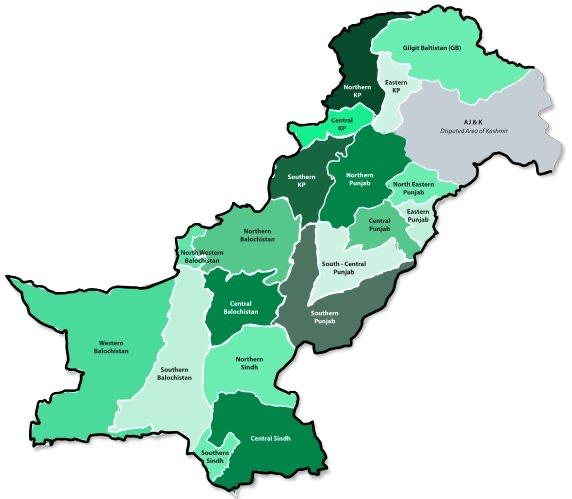
A child’s shoes are not replaced because they are broken; they are replaced because the child has outgrown them. Same is the case with administrative boundaries. Provinces which were drawn for yesterday’s population should not be expected to serve tomorrow’s nation. Refusing to redraw boundaries is not just about a political opinion or view; it is forcing a growing country to walk in shoes that no longer fit.
For the past few months in Pakistan, there have been many rumors suggesting that the 28th constitutional amendment will alter the limits of provincial boundaries and create more provinces for administrative reasons. While the government has maintained a strategic silence, the very whisper of possibility has ignited national debates among various scholars. If the creation of new provinces is indeed important for administrative reforms, we should support it in every possible way, as it does not threaten the federation. Rather, it is the logical next step in its evolution toward a more prosperous, equitable, and stable Pakistan.
The Constitution of Pakistan provides a meticulous framework for altering provincial boundaries, requiring a 2/3 majority in both houses of parliament and the assent of the province being affected. Under Article 239(4) of the Constitution of Pakistan, 1973, Majlis-e-Shoora (Parliament) has the power to amend or alter the limits of provinces, but it is subject to certain conditions:
- A two-thirds majority of both houses (the National Assembly and the Senate),
- A two-thirds majority of that provincial assembly whose provincial limits are being altered.
Creating new provinces is not about dividing the nation, it is about multiplying opportunity.
The legal argument for creating additional provinces is grounded in the very spirit of the Constitution. On 1st july, 1970, through the Legal Framework Order issued by President Yahya Khan, four provinces of Punjab, Sindh, Khyber Pakhtunkhwa (KP), and Balochistan were established in their current constitutional form. These four provinces were established to meet the needs of approximately 65 million people, but today we are a nation of over 240 million people. Administrative units designed for such a small population are now overburdened, inefficient, and unable to deliver the fundamental rights enshrined in the Constitution.
According to the 7th Digital Census published by the Pakistan Bureau of Statistics in 2023, the population of Punjab alone stood at 127.6 million. With an estimated annual growth of 2.53%, the figure has now risen to nearly 137.4 million in 2026. Managing such a vast province is an administrative nightmare, giving rise to bureaucratic inefficiencies, delayed decision-making and a profound disconnect between the government and the people. By creating more manageable provinces, we can bring the government closer to the people. New provinces would have their own police forces, secretariat, development authorities and judicial institutions, enabling them to respond more efficiently and swiftly to local needs.
The creation of new provinces would also address the economic grievances of many regions that have long been victims of underdevelopment. These areas have consistently complained that their resources have been exploited for the development of the distant Capital while receiving inadequate investment themselves. New provinces would allow more cities and regions to develop and prosper, particularly those that have remained neglected in the past, as development efforts were overwhelmingly concentrated in major urban centers and provincial capitals.
According to the OECD Report on Making Decentralisation Work (2019), dividing larger territories into smaller regional governments drives economic growth and productivity. The study found that balanced regional governance across thirty countries reduced inequalities by improving local resource use and public sector efficiency. World Bank data further confirms that provincial-level entities achieve significant efficiency gains. Being closer to the people, smaller units can deliver public services that better meet local needs at a much lower cost.
According to a World Bank state study, the creation of smaller subnational administrative units in India accelerated growth trajectories. Following its reorganization, Uttarakhand emerged as one of India’s fastest-growing states, experiencing rapid economic expansion and a significant reduction in poverty, driven largely by targeted development in the non-farm sector.
While new provinces risk fiscal strain, political friction, and systemic disparity, these transitional hurdles are manageable through prudent planning and will ultimately yield a more equitable and efficient federal structure.
The process must be legally sound, transparent, and agreed upon by all constitutionally required representatives in assemblies. A commission could be established to study the feasibility, administrative requirements, and boundaries of new administrative units. This would ensure that new administrative units reflect not political interests or opinions, but a well-considered strategy for administrative reforms, a more effective system of governance, and a better future.
The 28th Amendment is about making our government fit for today’s Pakistan. This is not just redrawing maps; it is bringing power closer to the people, respecting local identities, and making the federation stronger. Yes, we need care, consensus, and constitutional due process, but holding onto an outdated system is the real danger. I view this as our chance to grow as a nation, to embrace change wisely, and to show that unity and diversity can coexist. That is the Pakistan I believe in.
Bibliography:
- Constitution of Pakistan 1973, art 239(4).
- South Asia Index (@SouthAsiaIndex), ‘Pakistani govt to redraw provincial boundaries and create new provinces in Pakistan, via 28th amendment’ (X, 24 January 2026) https://x.com/SouthAsiaIndex/status/2015102755241947245 accessed 3 August 2026.
- ‘Census in Pakistan, Headcount and its Importance for Effective Governance’ (Jahangir’s World Times, 9 February 2017) https://www.jworldtimes.com/old-site/css-exclusive/css-special/census-in-pakistan-headcount-and-its-importance-for-effective-governance/ accessed 3 August 2026.
- Government of Pakistan, 7th Population & Housing Census 2023 (First Ever Digital Census) National Census Report (Pakistan Bureau of Statistics, 2023) https://www.pbs.gov.pk/wp-content/uploads/2020/07/National-Census-Report-2023.pdf accessed 3 August 2026.
- OECD, Making Decentralisation Work: A Handbook for Policy-Makers (OECD Publishing, 2019) https://www.oecd.org/en/publications/2019/03/making-decentralisation-work_g1g9faa7.html accessed 3 August 2026.
The opinions expressed in this article are the author's own and do not reflect the views of LEAP Pakistan or Pakistan College of Law.