- Legal Education and Access Portal

Justice for All or Justice for the Few? SDG 16.3 and the Access to Justice Crisis in Pakistan
Abstract
Sustainable Development Goal 16․3 (SDG 16․3) has committed through Target 16․3 to “promote the rule of law” and “ensure equal access to justice for all” by 2030․ Pakistan’s 129th out of 142 countries in the 2024 World Justice Project Rule of Law Index rank indicates that reaching SDG 16․3 is becoming a distant dream․ This article studies access to justice in Pakistan as a failure of SDG 16․3 implementation․ The three inter-correlating constraint variables identified are judicial backlog and delay (Variable A)‚ unavailability of legal aid on a structural level (Variable B) and access barriers on socio-economic and gender grounds (Variable C)․
The study adopts a qualitative‚ document-based methodology to investigate how constraints A‚ B and C cumulatively produce compounded forms of justice exclusion disproportionately experienced by the poor‚ women and marginalized groups in Pakistan through Legal Empowerment Theory‚ Amartya Sen’s Capability Approach‚ and the (OECD-WJP) Access to Justice Framework․ The literature review covers peer-reviewed research on judicial delay‚ legal aid policy‚ and measures of SDG 16․3‚ as well as studies conducted in Pakistan‚ concluding with a proposed conceptual framework and four hypotheses․ The article recommends court digitization‚ legal aid law reform‚ gender-responsive justice programming‚ and the SDGs 16․3 data reporting․ It identifies access to justice in Pakistan as a matter not only of legal concern‚ but a public policy problem with meaningful implications for poverty alleviation‚ gender equality and sustainable development․ To achieve SDG 16․3‚ it will be necessary to consider access to justice as a public service rather than a private good that can be paid for by those in need․
Keywords
SDG 16.3, access to justice, rule of law, Pakistan, legal aid, judicial delay, qualitative research, capability approach, legal empowerment, gender and justice, World Justice Project
- Introduction
- Background: The SDG 16.3 Commitment and Pakistan’s Reality
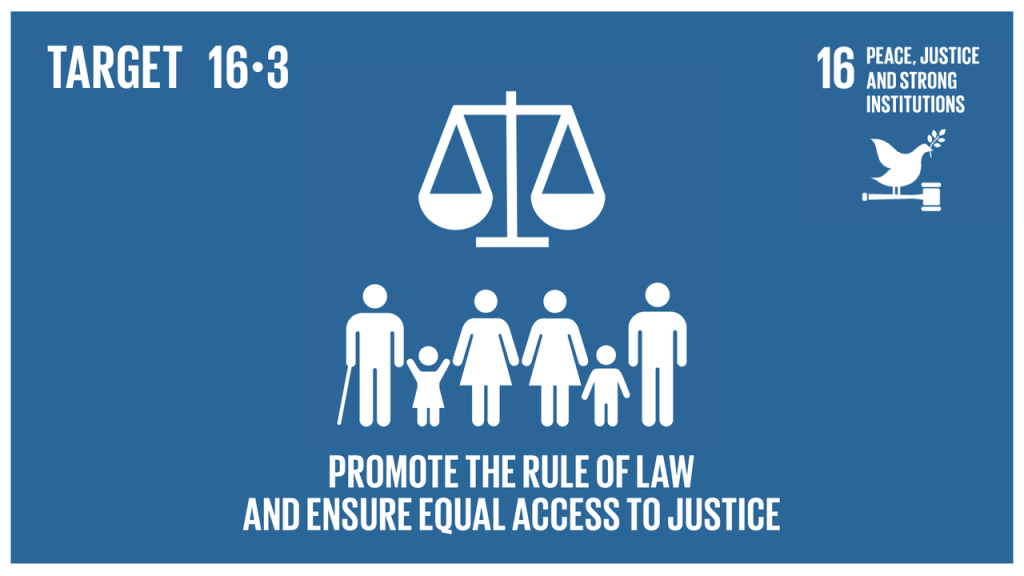
In September 2015, Pakistan became one of the 192 countries that signed on to the 2030 Agenda for Sustainable Development and its seventeen Sustainable Development Goals, as members of the United Nations. SDG number 16 – “Peace, Justice and Strong Institutions” – aims to foster a peaceful and inclusive society, develop effective institutions, and most importantly, ensure justice for all. Target 16.3 of the goal calls for nations to “promote the rule of law at the national and international levels and ensure equal access to justice for all.” The process of achieving this target will be achieved through three key indicators: SDG 16.3.1 (proportion of victims of violence who report to the police), SDG 16.3.2 (proportion of pre-trial detainees), and the latest indicator, SDG 16.3.3 (proportion of people with a civil justice problem in the last 2 years).
After 11 years of commitment to SDG 16.3, Pakistan has one of the toughest stories to tell in South Asia. According to the WJP Rule of Law Index 2024, Pakistan is placed at the 129th position out of 142 countries – specifically at 128th position in terms of civil justice and the 98th for criminal justice. In terms of order and security, Pakistan finds itself at the alarming 140th position – making Pakistan the third worst in the world after Mali and Nigeria. This is not a marginal story of poor performance but a systemic failure of the justice system that the country is committed to building under SDG 16.3. According to Dawn, Pakistan was part of those 63% of countries where the indicator of Fundamental Rights worsened in the past year, along with 59% where the indicator of Constraints on Government Powers worsened.
What is crucial about Pakistan’s justice crisis is not its ranks but its effects on people. According to Imran, Idrees, and Saeed (2024) in Current Trends in Law and Society (DOI: 10.52131/ctls.2024.0401.0031), 2.3 million cases are pending in the district judiciary of Pakistan, which is more than 80% of the total number of cases in Pakistan’s judicial system. Empirical studies have been published in the Annals of Human and Social Sciences (2026), according to which delays in Pakistan’s judicial process make the country occupy the 129th position in the ranking of countries on their rule of law performance and affect the outcomes of achieving SDGs. Rates of pre-trial detention are among the highest in the region. The system of legal aid is structurally non-existent for the vast majority of citizens. Women, poor people, and other marginalized groups of society are not able to access justice due to court fees, lack of geographical access, and social barriers.
The literature review shows how the various dimensions of this issue have been discussed individually. The foundational work on ‘Gender & Access to Justice in Pakistan’ done by Shaheed et al. highlights the structural obstacles women face in accessing justice. In 2023, the 2023 Policy Brief of the Institute of Strategic Studies Islamabad (ISSI) discusses the obstacles faced by Pakistan in achieving the targets related to SDG 16. In August 2025, an analysis conducted by Dawn on SDG 16 revealed certain deficiencies in Pakistan’s criminal justice reform efforts. Yet, there is a significant research gap that needs to be filled by a relevant publication integrating the obstacles mentioned above in the context of SDG 16.3 compliance.
- Problem Statement
Despite Pakistan’s adoption of SDG 16.3 in 2015, access to justice in Pakistan is systematically denied to the vast majority of the population because of the 2.3 million backlogged cases in district courts and the years-long backlog in the superior courts, so justice delayed becomes justice denied in practice for millions of Pakistanis who cannot afford prolonged litigation.
A national legal aid act is absent in Pakistan, which is a basic legislative tool necessary for compliance with SDG 16.3, which means that there is no systematic state effort to ensure access to free legal services, and the existing initiatives of NGOs, provincial programs, and law schools cover only a small percentage of the population’s legal needs, especially in rural areas, among women and religious and ethnic minorities.
The access gaps faced by marginalized groups such as the poor and women in Pakistan, which include issues like high court fees, geographical distance, judicial language, cultural traditions that discourage women from pursuing their legal rights independently, and the lack of gender-specific court processes, are not something that can be addressed by law reforms only; instead, they need an integrated public policy solution that recognizes justice access as a vital public service under Pakistan’s SDG 16.3 and constitution through Articles 4, 9, 10A, and 25.
-
Research Objectives
RO1: To examine the extent of Pakistan’s compliance with SDG 16.3 in terms of access to justice through an analysis of three main barriers – judicial delays (Variable A), unavailability of legal aid (Variable B), and socio-economic and gender exclusions (Variable C).
RO2: To analyze the effectiveness of Pakistan’s current legal and institutional framework in providing access to justice in comparison with the criteria set forth in SDG 16.3, the OECD Framework on Access to Justice, and lessons from South Asia
RO3: To explore the connections between the access to justice problem in Pakistan and its adverse impact on other SDGs (such as SDG 1, poverty; SDG 5, gender equality; and SDG 10, reduced inequalities).
RO4: To recommend a framework for legislation, institutional reforms, and policies for SDG 16.3 in Pakistan based on the international experience and Pakistan’s constitution.
2. Significance of the Study
At two levels, this research can be said to be contributory. Firstly, at the theoretical level, it creates a comprehensive framework for analyzing Legal Empowerment Theory, Sen’s Capability Approach, and the Access to Justice Framework in relation to the measurement of SDG 16.3 in the developing state. There has been no published research that combines these three frameworks for Pakistan in order to analyze the access to justice indicators. The conceptual model created in this research, which identifies the relationship between judicial delay, lack of legal aid provision, and socioeconomic disenfranchisement, can serve as an analytical tool for other developing states in South and Southeast Asia.
From a practical point of view, it is timely to publish this research at the current juncture. In addition to the fact that the deadline of 2030 for the achievement of SDGs by Pakistan is coming closer with access to justice indicators not achieving sufficient progress, the policy makers in Pakistan should take into consideration the GSP+ conditionality framework of the EU, in accordance with which Pakistan’s duty free market access to the EU will depend upon its success in implementing ICCPR and other human rights conventions, including access to justice provisions.
2.1 Qualitative Research Design
This article uses a qualitative research approach that combines three types of analyses. First, doctrinal legal analysis entails an evaluation of the legal aid statutes of Pakistan (Legal Aid and Justice Authority Act 2020 and Islamabad High Court Legal Aid Rules), the constitutional provisions (Articles 4, 9, 10A, 25), and the measurement indicators used under SDG 16.3. Second, comparative case analysis involves looking at the approaches taken by Bangladesh, India, and Sri Lanka with regard to legal aid legislation and court reforms aimed at meeting the requirements of SDG 16.3. Third, theoretical framework analysis involves applying the three theoretical frameworks to the three identified variables.
2.2 Data Sources
The primary sources comprise the Constitution of Pakistan 1973, the Legal Aid and Justice Authority Act 2020, reports by the Law and Justice Commission, the National Judicial Policy 2009-2025, and the Voluntary National Review submissions made by Pakistan on its SDGs achievements. The secondary sources consist of scholarly peer-reviewed articles published in academic journals such as Current Trends in Law and Society, Annals of Human and Social Sciences, Pakistan Journal of Law, Analysis and Wisdom, and the Journal of Development and Social Sciences, as well as reports published by the World Justice Project, OECD, UN SDG Secretariat, UN Department of Economic and Social Affairs, and Advocates for International Development SDG 16 Legal Guide.
3. Theoretical Frameworks
3.1.1 Legal Empowerment Theory (Variable B — Legal Aid Unavailability)
According to Legal Empowerment Theory, which has its roots in the work of Maru, Golub, and Minkler, legal rights will be able to provide their benefits only if the individuals who are meant to benefit from them have sufficient awareness, literacy, help, and institutional support to claim and enforce them. If they do not have this, they are not going to be able to enforce their rights effectively. In other words, legal rights are going to be symbolic and not substantive without legal empowerment. This is directly related to SDG 16.3, as Articles 10A and 25 of the Pakistani Constitution grant the citizens of Pakistan the right to a fair trial and the right to equality before the law, respectively.
Durojaye et al. (2020), in their article titled “Access to Justice in Developing States Context,” published in the Journal of African Law (DOI: 10.1177/1358229120969602), utilize this model in analyzing the issue of access to justice in the developing state context. They find out that the condition of “law on the books without law in action” — i.e., legal rights without empowerment infrastructure — is applicable in the justice systems of most of the less developed or middle-income countries. In the case of Pakistan, one can say that it applies to the country in totality.
3.1.2 Sen’s Capability Approach (Variable C — Socioeconomic and Gendered Exclusion)
Sen’s approach to development, which considers human capability as an important indicator of development, extended by Martha Nussbaum to incorporate the capability to “seek and obtain redress” as an important capability of humans, offers the normative approach to the analysis of justice exclusion as a denial of basic freedom. Sen states that development should not be considered solely in terms of income; rather, development should be considered in terms of the actual freedom that people have to enjoy those freedoms that they have reason to value. And access to justice is one of such freedoms since without it no other freedoms can be effectively protected.
Applying the Capability Approach to Pakistan’s access to justice problem shows that this issue is not only a failure of law and institutions but also a failure of development, since the deprivation of poor Pakistanis, those living in rural areas, women, and minorities of their ability to have access to justice means that their capabilities to claim and enforce other rights are deprived. As it is proven by Shaheed et al. in their analysis published on ResearchGate, poor women in Pakistan are deprived of the ability to have access to justice through three barriers – lack of financial resources (lawyers are costly), geographical distance between rural areas and courts, and institutional barriers (the legal system is dominated by men and is unfriendly towards women’s claims).
3.1.3 The Access to Justice Framework (Variable A — Judicial Delay)
Timely resolution of legal problems is one of the key components of justice access as described in the Access to Justice Framework developed most systematically by the Access to Justice Working Group at the OECD and put into practice in the OECD’s 2023 report on how to improve the monitoring of SDG 16.3.3. Delayed justice is not only something that does not work but also something that causes active harm through increased uncertainty, expenses, and absence of remedies when they can be obtained. It is not just an expression that “justice delayed is justice denied” it is a proven link between delays and justice access outcomes.
This principle is reflected in the World Justice Project’s Access to Civil Justice Indicator of SDG 16.3.3, in which access to justice is measured based on whether people having civil legal problems manage to get legal advice, assistance, or representation and resolve their legal problems — this indicator measures the institutional and experiential aspects of access to justice. There is no data on Pakistan’s SDG 16.3.3 performance because the country has not yet provided its data for this indicator.
3.2 Key Concepts
3.2.1 SDG 16.3 and the Justice-Development Nexus
As stated by the United Nations SDGs Department of Economic and Social Affairs (2026), the extended report on SDG 16 is clear that justice is not only a goal itself but also a driver for all other SDGs, as it is impossible to advance poverty alleviation, gender equality, and economic development without the operation of justice systems that respect property rights, ensure contract enforcement, offer remedies against gender-based violence, and keep the states accountable. The link between justice and development is relevant for Pakistan, since the inability of smallholder farmers to enforce land rights, women to benefit from family law measures, and laborers to enforce labor rights hinders SDGs 1, 5, and 8, respectively.
The assessment by Dawn on SDG 16 and peace in Pakistan states, “South Korea and Sierra Leone have created legal aid corporations and justice centers that have helped in millions of cases, thereby increasing equitable access to law” – an example that illustrates what the Pakistani National Legal Aid Authority can accomplish when set up properly. The paper further highlights that although the national action plan of Pakistan emphasizes criminal justice reforms among its priorities, “Federal actions need to be converted to action plans at all provinces’ levels.”
3.2.2 Pakistan’s Judicial Delay Crisis
Recent doctrinal study by Imran, Idrees and Saeed (2024) provides a detailed analysis of the delay in the judicial process in Pakistan, indicating that 2.3 million cases are pending in the district judiciary alone, which is more than 80 percent of the total number of cases. Reasons for this phenomenon are varied and interconnected, ranging from archaic laws permitting unlimited adjournments; lack of sufficient judges (there are only 17 judges per million people in Pakistan as compared to the minimum requirement of 50 as determined by the Law and Justice Commission); inadequate infrastructure of the court system especially in rural districts; and legal culture of both the judges and lawyers who do not view procedural efficiency as an important part of their professional life. Acquittal rate is high in Pakistan, and according to the 2024 analysis of the criminal justice system in Pakistan conducted by Pakistan Journal of Law, Analysis and Wisdom, it is mainly due to trial delay and backlog.
Empirical evidence provided by the Annals of Human and Social Sciences 2026 study (DOI: 10.35484/ahss.2026(7-II)15) shows that there is a causative link between judicial delays and SDG achievements; judicial delay has a negative correlation with the performance of the rule of law in all aspects of the World Justice Project Rule of Law Index, as well as the 129th global ranking of Pakistan.
3.2.3 Legal Aid: The Missing Infrastructure
According to the Advocates for International Development (A4ID) SDG 16 Legal Guide, legislation relating to legal aid provision could be considered among the most immediate legislative measures that countries can use to ensure their SDG 16.3 obligations, since SDG 16.3’s “access to justice for all” goal cannot be achieved if cost becomes an impediment to the provision of legal aid. The Legal Aid and Justice Authority Act 2020 of Pakistan, which is the first-ever federal legal aid law of the country, could be considered a significant step in this direction; however, it has faced severe restrictions due to a lack of funding and other issues.
According to the ISSI’s policy brief from 2023 on Pakistan and SDG 16, “challenges still exist in providing universal access to justice and enforcing the rule of law in Pakistan. Issues like backlogs in judiciary, limited resources, and socio-cultural obstacles need to be overcome.” This policy brief’s comparative analysis of the performance of Pakistan in SDG 16 vis-a-vis other South Asian countries shows that “legal aid coverage in Pakistan is much lower than the regional average and global average for lower-middle-income countries” and that, due to the lack of provincial legislation regarding legal aid in Punjab, KP, and Balochistan provinces, the majority of Pakistani citizens outside Sindh and Islamabad cannot obtain legal help for free.
3.2.4 Gender and Justice: The Compounded Exclusion
Gender aspects of the crisis of justice in Pakistan have been very well researched. The study by Shaheed et al identifies that there are three tiers of justice exclusion faced by women in Pakistan – economic exclusion (the legal process costs are prohibitively high for most women since women don’t have independent control over their incomes), cultural exclusion (women’s independence of movement and ability to file legal cases through societal pressures restricts access to courts especially in rural settings) and institutional exclusion (the predominantly male-dominated judiciary and lack of sensitivity of the legal professionals to women’s needs).
In line with the UN DESA SDG 16 Progress Report (2026), rising discrimination in the world, with the average discrimination rate going up from 14.8% to 17.1% between 2015, is linked to decreased access to justice for disadvantaged groups. In Pakistan’s case, rising global discrimination trends have been influenced by deep-rooted patriarchal values, the practice of parallel customary justice (jirgas and panchayats that discriminate against women), and blasphemy laws and anti-conversion narratives that impact minorities in particular. The resulting access to justice issue has been an issue of gender, minority rights, and SDG 16.3 implementation.
3.3 Conceptual Framework
The conceptual framework below brings together the three theoretical models and three variables to explain how the lack of access to justice in Pakistan is a non-compliance issue of SDG 16.3. The interaction of variables A, B, and C combines to cause Justice Exclusion (Outcome D), which will in turn hinder the progress of Pakistan in SDG 16.3 and SDGs in general. The three theoretical models underpin the analysis of the three variables that combine to create the outcome.
3.4 Research Hypotheses
H1 (Judicial Delays Hypothesis):
The backlog of cases numbering 2.3 million in the district judiciary of Pakistan, combined with the procedural ability to take an indefinite number of adjournments and a ratio of about 17 judges per million people, serves as an important reason for the failure to achieve SDG 16.3 in that it prevents the population of Pakistan from having timely access to civil and criminal justice.
H2 (Legal Aid Hypothesis):
The structural impossibility of legal aid in Pakistan as demonstrated by the lack of legal aid legislation in Punjab, KP, and Balochistan provinces and the insufficiently funded federal Legal Aid and Justice Authority represents an independent and important obstacle to SDG 16.3 achievement, which means that the constitutional right to a fair trial (Article 10A) remains unattainable to most poor Pakistanis without legal assistance.
H3 (Gendered Exclusion Hypothesis):
A combination of socioeconomic and gender-based obstacles to accessing justice such as court fees, the geographic distance from courts, cultural constraints on the independence of women in litigation processes, and parallel customary justice mechanisms will exacerbate the impacts of Variables A and B, thus generating an exclusion from justice pattern that is predominantly experienced by women, poor people, rural areas, and members of religious minorities, which amounts to an intersection of SDG 16.3 with SDG 5 (gender equality) and SDG 10 (reducing inequalities).
H4 (Reform Hypothesis):
A reform strategy combining all three variables at once – court digitalization and judicial capacity expansion (Variable A), legal aid legislation and its implementation at the national/provincial level (Variable B), and gender-specific justice programming and SDG 16.3.3 data gathering (Variable C) – will lead to greater SDG 16.3 success compared to fragmented reforms focused on each variable separately, in line with the integrated approach of the OECD Access to Justice Framework.
- Pakistan’s Access to Justice Landscape: Evidence Across the Three Variables
4.1 Variable A: Judicial Delay and the Pendency Crisis
The judicial backlog issue in Pakistan is amongst the most serious in South Asia. According to Imran et al. (2024), 2.3 million cases pending in the district judiciary constitute over 80% of the total case burden, and there are average waiting periods measured in years and not months before dispute settlement of civil matters. Structural and cumulative factors include complicated procedural regulations that allow unlimited adjournment; shortage of judicial personnel (Pakistan has 17 judges per million of its population, compared to the 50 suggested by Law and Justice Commission); lack of proper infrastructure of the courts, especially in the rural and peri-urban areas; and legal culture where adjournments are a frequent practice.
According to the WJP Rule of Law Index 2024, Pakistan is ranked 128th in civil justice and 98th in criminal justice, which indicates not just the pendency issue but the overall quality, availability, and impartiality of the justice system of Pakistan. Empirical research published in the Annals of Human and Social Sciences 2026 about judicial delays and the impact of SDGs in Pakistan quantitatively validates a causal link between delay and the failure to achieve SDGs, proving that the judicial delay problem of Pakistan is not only a nuisance but a hindrance to sustainable development.
4.2 Variable B: Legal Aid — The Missing National Infrastructure
Pakistan’s enactment of the first-ever legal aid legislation of the country, in the form of the Legal Aid and Justice Authority Act 2020, is certainly a landmark moment in terms of legislation. Under the Act, the Legal Aid and Justice Authority (LAJA) will be established, along with providing free legal assistance to impoverished individuals accused of committing crimes, and creating a structure to extend legal aid services. However, there have been several restrictions on the implementation of the Act, including the limited functioning of LAJA in Islamabad only; the budget allocated to the organization is far less than what is needed to address the legal needs of hundreds of thousands of Pakistanis; and while the Act addresses the legal assistance needed for criminal cases, it is limited in terms of civil law issues.
The lack of legal aid in Punjab (pop. 130 million), Khyber Pakhtunkhwa, and Balochistan leaves the majority of the population in Pakistan, other than those of Sindh and Islamabad, without any official mechanism through which they can obtain free legal help other than NGO and law school clinic help, which has limited capability and geographical coverage. As confirmed by the 2023 SDG 16 policy brief of ISSI, “capacity development within the justice sector is essential for the successful delivery of SDG 16-related activities,” and that “financial constraints” form one of the major hindrances to SDG 16.3.
4.3 Variable C: Socioeconomic and Gendered Barriers
The socioeconomic obstacles preventing poor people in Pakistan from accessing justice are piling up. Firstly, the costs of going to court and hiring an advocate are prohibitively high. Secondly, the geographic obstacle – there are hours of travel to get to the nearest operational court – means not only the direct transportation and accommodation costs but also the indirect opportunity cost, as people will not be able to work on their land or do their informal sector jobs. Thirdly, the formal justice system uses only English and Urdu languages, making it hard for speakers of Sindhi, Pashto, Punjabi, Saraiki, and Balochi who may not be even literate in the official language.
In addition to this analysis carried out by Shaheed et al., there are also customary mechanisms for conflict resolution in the form of jirgas and panchayats, which operate independently alongside the regular process of justice delivery in Pakistan. These mechanisms have been shown to systematically violate the constitutional rights of women despite enjoying power within the community that is very difficult for courts to challenge. In rural Pakistan, customary conflict resolution mechanisms have been used extensively for solving disputes relating to land, familial relations, and interpersonal disagreements.
“In Pakistan, the female literacy rate is 30%. A majority of the women involved in legal disputes come from poor and illiterate backgrounds. These women have no access to legal aid.” — Shaheed et al., ResearchGate
- Comparative Perspectives: What Pakistan Can Learn
The problem faced by Pakistan regarding SDG 16.3 is not uncommon among South Asian countries – all developing nations encounter similar issues related to the lack of judicial capacity, lack of legal aid and lack of access mentioned above; however, the lessons learned from experiences of neighboring South Asian countries and other lower-middle-income countries offer useful examples of how to address these problems.
Bangladesh has set up the National Legal Aid Services Organization (NLASO) in the year 2000, which offers legal aid for free for poor people in all districts with 64 district-level and 8 metro-level legal aid committees. This example, where the scope reaches around 800,000 individuals per year, can be used by the legal aid legislation of provinces in Pakistan as they need such. According to Dawn’s SDG 16 report, “Sierra Leone has set up legal aid corporations and justice centers that have offered help in millions of cases, making legal access equitable”
The experience that India has had with the digitisation of their courts, which includes the eCourts Mission Mode Project in which over 240 million court files have been digitised and online filing and hearing of cases are now possible, offers a ready example of how to go about digitising the courts of Pakistan. As reported by Dawn, the Supreme Court of Pakistan has made its very first attempt at establishing an e-court — a move in the right direction that must be extended to the district courts.
- Findings and Recommendations
6.1 Key Findings
First, it is clear that Pakistan’s access to justice problem constitutes an SDG 16.3 failure: the 2.3 million case backlog, 128th out of 142 civil justice ranking, and lack of legal aid legislation in three out of four provinces clearly constitutes a systematic failure of the “access to justice for all” pledge which cannot be described as underperformance.
Second, the three variables considered in this study – judicial delay, lack of legal aid, and socio-economic as well as gender-related barriers – work together in a way predicted by Hypothesis 4: reforms aimed at each variable in isolation from the others yield no substantial progress. The reduction of delays without increasing access to legal aid fails to assist poor litigants who cannot pay lawyers despite reduced waiting times. The increase in access to legal aid without introduction of gender-sensitive court procedures fails to reach women.
Thirdly, Pakistan’s data gap with regards to SDG 16.3.3 – which is the lack of systematic reporting by the country on the proportion of people who have access to civil justice services – is a governance problem that hampers accountability of justice access outcomes, and the evidence-based approach to reforms needed under SDG 16.3.
Fourthly, the access to justice crisis overlaps with and constrains the realization of SDGs 1 (end poverty), 5 (gender equality), and 10 (reduce inequalities) in such a way that justice sector reform becomes a key element of Pakistan’s development agenda, rather than being just a legal one.
6.2 Recommendations
For the Parliament: Develop and enact a National Legal Aid Act, which builds and expands on the LAJA framework introduced in 2020, requiring provincial legal aid laws, developing minimum standards of services, establishing a mechanism for monitoring, and providing a dedicated funding stream for legal aid provision. This should be a civil and criminal legal aid act, with special provisions made for women’s legal aid requirements, such as in family law cases, inheritance, and gender-based violence cases.
For the Judiciary: Introduce reforms to case management that include restricting adjournments (no more than three per case unless there is exceptional reason for more); expanding e-filing, e-hearing, and digitisation of case management from the Supreme Court level to the District Courts through a five-year roadmap; increasing judicial officer numbers to the minimum recommended by the Law and Justice Commission of at least 50 per million of the population; and introducing gender-sensitive family courts in each district.
For the Executive: Conduct the first SDG 16.3.3 survey in Pakistan, which will be a representative survey measuring the extent of civil legal problems and the use of justice services in Pakistan, to build an evidence base for reform. Incorporate access to justice indicators into the provincial annual development plans and Voluntary National Reviews of Pakistan on the SDGs.
For Civil Society: The NGOs working on legal aid, law school clinics, and bar associations should conduct a mapping exercise of legal aid in Pakistan to pinpoint areas where access is lacking. Provincial legislation on legal aid in Punjab, Khyber Pakhtunkhwa, and Balochistan is the best legislative approach to expanding SDG 16.3 compliance in Pakistan.
- Conclusion
The target SDG 16.3 poses a seemingly straightforward question: does everybody in Pakistan have access to justice? The facts provided by this paper provide the answer to the question clearly: not for most Pakistanis, who belong to poorer and rural communities, women, and minorities. A backlog of 2.3 million cases denies access on time; the lack of provincial legal aid legislation denies affordability; socioeconomic and gender-related constraints deny feasibility; and non-measurement of SDG 16.3.3 data by Pakistan denies any access monitoring.
The 2030 target date for SDG 16.3 is not a far-off goal – it is just four years from now. The disparity between Pakistan’s present ranking (129th in the world; 128th for civil justice) and the “access to justice for all” norm is not shrinking quickly enough for that date without a reform program of the sort advocated in this paper. While the institutional measures involved – passage of a National Legal Aid Act, mandatory case management system reforms, SDG 16.3.3 data gathering, gender-sensitive court processes – may be within the reach of Pakistan’s institutional capabilities, what is needed is the political will to understand that access to justice is not a “nice-to-have” option, but a basic public good.
The dream that Muhammad Ali Jinnah envisioned at the time of the foundation of Pakistan included the establishment of a legal system in which all citizens could get justice without discrimination. This has become the duty of Pakistan as part of UN SDG 16.3. It is a legal duty within Pakistan on account of Articles 4, 9, 10A, and 25 of the constitution. Now the last thing that needs to be done is to implement this dream into reality.
Bibliography:
Advocates for International Development (A4ID). (2021). A legal guide: SDG 16 — peace, justice and strong institutions. https://a4id.org/wp-content/uploads/2023/04/SDG-Legal-Guide_Chapter-16_FinalNew.pdf
Constitution of the Islamic Republic of Pakistan, 1973. National Assembly of Pakistan. https://na.gov.pk/en/content.php?id=2
Dawn. (2024, October 26). Pakistan third-worst country for law and order, security: World Justice Project. https://www.dawn.com/news/1867657
Dawn. (2025, August 7). Peace and justice. https://www.dawn.com/news/1929236
Durojaye, E., Mirugi-Mukundi, G., & Adeniyi, O. (2020). Legal empowerment as a tool for engendering access to justice in South Africa. Journal of African Law, 65(1), 51–71. https://doi.org/10.1177/1358229120969602
Hoorain, A. (2023). Pakistan and SDG 16: Peace, justice, and strong institutions. Islamabad Policy Research Institute / Institute of Strategic Studies Islamabad. https://issi.org.pk/wp-content/uploads/2023/08/IB_Hoorain_Aug_10_2023.pdf
Imran, M., Idrees, R. Q., & Saeed, M. A. (2024). Pendency of cases in Pakistan: Causes and consequences. Current Trends in Law and Society, 4(1), 52–61. https://doi.org/10.52131/ctls.2024.0401.0031
Journal of Social Sciences Research and Policy. (2026). An empirical analysis of judicial delays and their impact on rule of law and SDG outcomes in Pakistan. Annals of Human and Social Sciences, 7(2), 176–191. https://doi.org/10.35484/ahss.2026(7-II)15
Minute Mirror. (2022, November 27). Peace, justice and strong institutions (SDG 16) — case of Pakistan. https://minutemirror.com.pk/peace-justice-and-strong-institutions-sdg-16-case-of-pakistan-75464/
OECD. (2023). Improving the monitoring of SDG 16.3.3: Towards better access to justice. OECD Publishing. https://www.oecd.org/content/dam/oecd/en/publications/reports/2023/09/improving-the-monitoring-of-sdg-16-3-3_ba6098ca/c5fbed7e-en.pdf
Pakistan Journal of Law, Analysis and Wisdom. (2024). Acquittal rates and the crisis of criminal justice in Pakistan. Pakistan Journal of Law, Analysis and Wisdom, 3(11), 203–218. https://pjlaw.com.pk/index.php/Journal/article/download/v3i11-203-218/v3i11-203-218
Pakistan Justice Network. (2024, October 24). Pakistan ranks 129 out of 142 in the World Justice Project Rule of Law Index. https://pjn.org.pk/blog/post/2393
ProPakistani. (2024, October 26). Pakistan ranks 129th on 2024 Rule of Law Index. https://propakistani.pk/2024/10/26/pakistan-ranks-129th-on-2024-rule-of-law-index/
Shaheed, F., Warraich, S. F., Balchin, C., & Gazdar, A. (n.d.). Gender and access to justice: A Pakistan case. ResearchGate. https://www.researchgate.net/publication/261810408_Gender_and_access_to_Justice_A_Pakistan_Case
The News. (2024, October 26). Pakistan 129th out of 142 countries in Rule of Law index. https://www.thenews.com.pk/print/1244078-pakistan-129th-out-of-142-countries-in-rule-of-law-index
United Nations Department of Economic and Social Affairs. (2026). SDG 16: Peace, justice and strong institutions — extended progress report 2026. UN DESA. https://sdgs.un.org/goals/goal16
United Nations Pakistan. (n.d.). Sustainable Development Goal 16: Peace, justice and strong institutions. https://pakistan.un.org/en/sdgs/16
United Nations Sustainable Development. (n.d.). Goal 16: Peace, justice and strong institutions. https://www.un.org/sustainabledevelopment/peace-justice/
World Justice Project. (2024). WJP Rule of Law Index 2024: Pakistan country profile. https://worldjusticeproject.org/rule-of-law-index/global/2024/Pakistan/
World Justice Project. (n.d.). Access to civil justice indicator proposal for SDG target 16.3.3. https://worldjusticeproject.org/our-work/publications/working-papers/access-civil-justice-indicator-proposal-sdg-target-1633
Zaheer, H. (2024). The rule of law in Pakistan: Challenges and reforms. LEAP Pakistan. https://leappakistan.com/the-rule-of-law-in-pakistan-challenges-and-reforms/
Zobairi, I. (2023). Pakistan and SDG 16 — peace, justice and strong institutions. Ziauddin University. https://zu.edu.pk/wp-content/uploads/2024/09/SDG-16-Peace-Justice-and-Strong-Institutions.pdf
The opinions expressed in this article are the author's own and do not reflect the views of LEAP Pakistan or Pakistan College of Law.