- Legal Education and Access Portal

Trump travel ban faces new legal assault in Virginia court
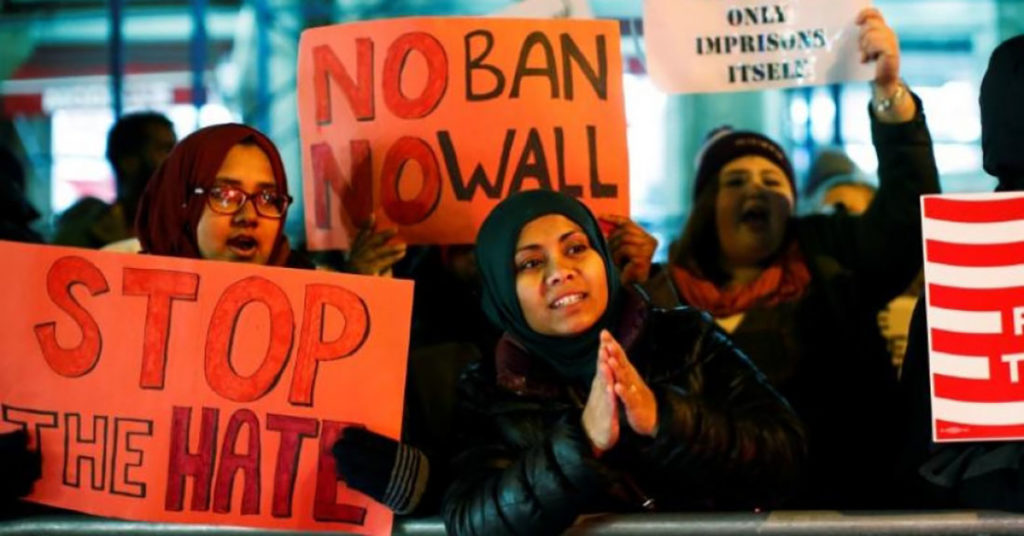
Donald Trump’s travel ban faces a fresh legal challenge, a day after it suffered an appeals court setback.
Lawyers for the state of Virginia are arguing in a federal court there is “overwhelming evidence” the policy “resulted from animus toward Muslims”.
On Thursday, an appeals court said the Trump administration failed to offer “any evidence” to justify the measure.
But the seven-nation ban has not been struck down; it is just in limbo while courts debate its legality.
What’s this Virginia case?
It is one of a dozen lawsuits now moving through the US court system against the Trump administration’s policy.
A federal court in the Washington DC suburb of Alexandria is holding a hearing on a request for a preliminary injunction on aspects of the ban.
The case is being brought on behalf of travellers detained at Dulles International Airport, or denied entry after the ban went into effect.
Virginia Attorney General Mark Herring’s spokesman said it would be “the most in-depth examination of the merits of the arguments against the ban”.
The challenge focuses on the travel restrictions imposed by the ban, rather than the four-month suspension of refugee admissions.
Virginia says the state, its residents and its public universities are harmed by the policy.
But lawyers for the US government wrote that Virginia did not have the right to challenge it.
“Judicial second-guessing” of the president’s steps to safeguard national security amount to “an impermissible intrusion” on his constitutional authority, they wrote.
The case will be heard by Judge Leonie Brinkema, who was appointed by President Bill Clinton in 1993.
What happened on Thursday?
The 9th US Circuit Court of Appeals said it would not block a ruling by a Seattle court a week ago that halted Mr Trump’s 27 January executive order.
The San Francisco-based court’s three judges unanimously agreed that the government had not proved that any terror threat justified reviving the ban.
It means visa holders from Iran, Iraq, Libya, Somalia, Sudan, Syria and Yemen can continue to enter the US, and refugees from around the world, who were also subject to a temporary ban, are no longer blocked either.
But the ruling does not affect one part of Mr Trump’s controversial executive order: a cap of 50,000 refugees to be admitted in the current fiscal year, down from the ceiling of 110,000 established under Barack Obama.
What appeals court ruling means – by Anthony Zurcher, BBC News, Washington
Donald Trump’s lawyers did not make their case. In fact, according to three 9th Circuit judges, they did not even really try to make their case. Rather than explaining why the temporary travel ban was needed, the administration argued that the president’s authority on immigration was so sweeping that they did not have to explain why the order was necessary.
According to the court, the government was unable to say why Mr Trump’s ban addressed a pressing national security threat that a temporary stay of the order would worsen. The lawyers for the challenging states, on the other hand, convinced the judges that re-imposing the order at this point would create further chaos by infringing on the due process rights of those on US soil, regardless of their immigration status.
By issuing a unanimous, unsigned opinion, the judges avoid accusations of partisan bias, as one of the three was a Republican appointee.
Mr Trump tweeted a sharp “SEE YOU IN COURT” following the decision – but which court? An appeal to the Supreme Court seems likely, although a better move for the president may be to fight in the lower court until Judge Neil Gorsuch joins the top court, establishing a conservative majority on the bench.
What was the reaction?
On Friday morning, Mr Trump was still fuming about the ruling, calling it “a disgraceful decision!”
But it is not clear if he intends to ask the US justice department to file an emergency appeal to the Supreme Court, or keep battling in the lower courts.
Mr Trump is currently trying to fill a vacancy on the nine-seat bench of the highest court in the land, which is seen as ideologically split 4-4.
Republicans said Thursday’s ruling was to be expected from a court that is widely perceived to be liberal-leaning.
Some legal commentators criticised aspects of the decision, including its lack of comment on a 1952 law giving the president power to suspend entry of “any class of aliens” when he finds their entry “would be detrimental” to the country.
However, the law was revised in 1965 to stipulate that immigrants could not be denied a visa because of their race, sex, nationality or place of birth.
Source: BBC
The opinions expressed in this article are the author's own and do not reflect the views of LEAP Pakistan or Pakistan College of Law.