- Legal Education and Access Portal

Between Refuge and Removal: Afghan Refugees in Pakistan
Abstract
Pakistan hosts one of the largest Afghan refugee populations in the world and yet it is not a signatory to the 1951 Refugee Convention or its 1967 Protocol, nor does it have a comprehensive domestic refugee law. Afghans in Pakistan are instead governed through a patchwork of ad hoc arrangements layered over the Foreigners Act 1946. This article traces that legal framework, its treatment in Pakistani case law, and its practical consequences. Additionally, it argues that the mass deportation drive that has intensified through 2025 and 2026 demonstrates the structural failure of governing a large, protracted refugee population through temporary administrative permits rather than a durable legal status.
The Absence of a Domestic Refugee Framework
Pakistan is not a party to the 1951 Refugee Convention or its 1967 Protocol, the principle international instruments defining refugee status and state obligations towards refugees. It has never enacted comprehensive domestic refugee legislation. Afghan refugees have instead been governed through temporary administrative arrangements. These include the Proof of Registration (PoR) card system, introduced in 2006 under UNHCR auspices, and the Afghan Citizen Card (ACC) introduced in 2017 for undocumented Afghans who arrived after the PoR registration process closed. Both confer a form of temporary legal stay and limited access to education and healthcare, but neither confers refugee status or a pathway to permanent residence or citizenship. Additionally, both remain subject to periodic government-set expiry date and renewal or extension decisions.
This structure means that the legal security of millions of Afghans in Pakistan, many of whom have lived there for decades, depend entirely on the government’s willingness to extend administrative permits rather than on any fixed legal entitlement.
The Governing Statute: Foreigners Act, 1946
In the absence of refugee-specific legislation, Pakistani courts have had to determine which statute applies to Afghan refugees. In Ghulam Sanai v. The Assistant Director, National Registration Office (PLD 1999 Peshawar 18), the Peshawar High Court held that refugees are governed by the Foreigners Act, 1946 rather than the Citizenship Act, 1951. This was because the Citizenship Act does not use the word “refugee” within Section 4. This was done on the basis that anyone who is not a citizen is, for legal purposes, a foreigner.
The Foreigners Order, 1951, as amended in 2000, permits Pakistan to refuse entry to a foreigner travelling without valid documents. While it distinguishes refugees from other foreigners, it makes no substantive provisions for them. The Foreigners Act itself, under Section 3(2), empowers the government of Pakistan to determine conditions of entry, and permits detention and arrest of foreigners in the interest of national security. Section 14-D, inserted by the Foreigners (Amendment) Act 2016, requires any foreigner without permission to remain in the country to apply for registration with NADRA, and permit work under section 14-D(2).
There are, however, constitutional limits on this power. In the Muhammad Akbar Cheema case, the Lahore High Court reiterated that the Foreigners Act cannot be applied in a manner that infringes Article 10 of the Constitution of Pakistan, 1973, which protects all people, not only citizens, from arbitrary arrests and detention. This is a significant constitutional constraint on how the foreigners act may be applied to Afghan nationals.
Detention, Documentation, and Daily Life
Afghans over the age of 5 without a PoR card are treated as illegal foreigners under Pakistani law and may be detained absent valid documentation. The practical consequences extend well beyond the risk of arrest. Without a PoR card or visa, Afghans are frequently unable to obtain SIM cards, open bank accounts, or receive remittances from relatives abroad. They are routinely excluded from formal employment, pushing many into low-wage informal work where they are vulnerable to exploitation and, per multiple human rights reports, to extortion by landlords and local officials.
Responsibility for refugee affairs sits with the Ministry of Interior, which regulates the visa regime through the national aliens registration authority (established in 2001). Meanwhile, the Commissionerate for Afghan Refugees, under the Ministry of States and Frontier Regions (SAFRON), coordinates with international bodies including UNHCR and the International Organisation for Migration.
The Deportation Campaign: 2023 to 2026
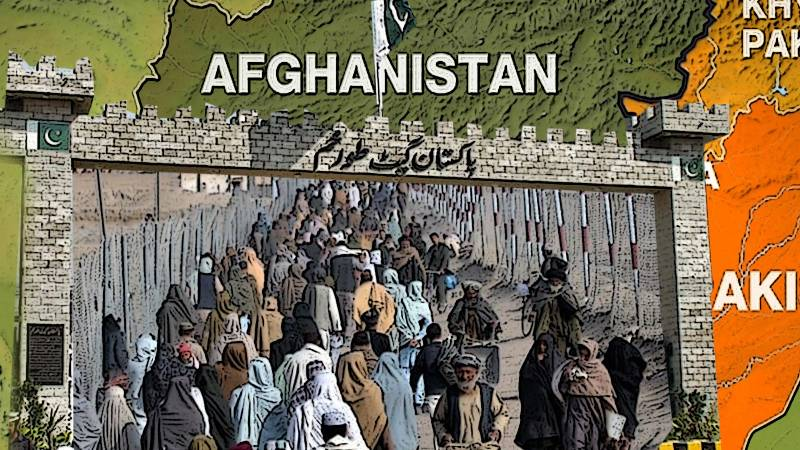
Pakistan’s “Illegal Foreigners’ Repatriation Plan,” launched in October 2023, marked a sharp escalation in enforcement against undocumented Afghans and against documented cardholders as well. Human Rights Watch has described the resulting returns as among the largest forced population movements in the region in recent years. The scale has grown substantially year on year. By 2025, more than 1,000,000 Afghans had been forcibly returned from Pakistan. In 2026 alone, over 146,000 further Afghans have been deported as of April, with deportations accelerating sharply since the reopening of the Torkham border crossing on 31 March 2026.
Significantly, this most recent phase has begun to reach populations previously considered comparatively protected. The Office of the UN High Commissioner for Human Rights describe the mass expulsions in a March 2026 briefing as amounting to collective punishment, noting that even registered PoR cardholders have lost status without due process. This marks a material change from the position as recently as 2024-25, when PoR holders were treated as a protected category pending later-expiring permits while ACC holders and undocumented Afghans board the initial brunt of enforcement.
Reporting from Human Rights Watch and Amnesty International documents recurring patterns in how deportations are carried out. These include night raids, destruction of identity documents, demands for bribes, confiscation of property, and forced returns of individuals with valid visas or registration, including at least 9 Afghan journalists reported by Reporters Without Borders since the start of 2026. Women deportees have reported additional risks of harassment and assault during the process.
Pakistan operates at least 49 detention centres for foreigners, none of which are subject to dedicated legislative regulation. Amnesty International has reported that detainees in several such centres were denied basic fair-trial guarantees, including access to legal counsel and communication with family.
Statelessness and the Second Generation
A distinct and increasingly significant legal problem concerns Afghans born on Pakistani soil to parents who themselves hold no secure status. Pakistan’s Citizenship Act, 1951 grants citizenship by birth under Section 4, but this provision has historically been applied restrictively to children of Afghan parents. This was done out of official concern that a generous interpretation would confer citizenship on a very large population. The practical result is a second and now third generation of Afghans comprising of individuals who have never set foot in Afghanistan. These individuals, in many cases, do not speak Dari or Pashto as a first language and remain classified as foreign nationals under Pakistani law. They are subject to the same PoR/ACC administrative regime and the same deportation risk as recent arrivals.
This generational dimension complicates the deportation campaign in ways that a purely bilateral, state-to-state framing does not capture. A person deported to Afghanistan who was born and raised entirely within Pakistan is not being “returned” in any meaningful sense. They are being expelled to a country with which their only connection is nationality of origin inherited through a parent. International law’s concern with statelessness and its consequences have been set out in the 1954 Convention Relating to the Status of Stateless Persons. Pakistan is not a party to this convention, but its core protections are widely regarded as reflecting customary international norms. These concerns are directly engaged by this pattern, even though Pakistan’s domestic law does not recognise statelessness as a legal category requiring protection.
Access to Education and Healthcare
The PoR and the ACC systems nominally provide their holders with access to public education and healthcare on terms broadly comparable to those available to Pakistani nationals. UNHCR and its partner organisations have worked to expand school enrolment among registered Afghan children. In practise, however, access remains substantially constrained by the same documentation barriers that affect employment and banking. Schools and hospitals frequently required valid CNIC or PoR documentation as a precondition for enrolment or treatment. The periodic lapses in PoR card validity translate directly into interruptions in children’s schooling and in access to routine healthcare. Undocumented Afghans, and increasingly Afghans whose PoR status has lapsed amid the current deportation drive often rely on informal or NGO-run facilities where these exist.
This pattern illustrates a broader feature of Pakistan’s administrative approach. Because legal status is not fixed but periodically renewed at the government’s discretion, every downstream entitlement tied to that status is rendered similarly provisional. A refugee framework grounded in durable legal status, by contrast, would decouple these entitlements from the government’s periodic and politically contingent renewal decisions.
The Role of International Organisations
UNHCR’s engagement with Afghan refugees in Pakistan has centred on registration, documentation support, and advocacy for continued PoR validity. They operate in coordination with the Commissionerate for Afghan Refugees under SAFRON. UNHCR does not have the authority to confer legal status under Pakistani domestic law. Its role has instead been to support the government’s own administrative registration systems and to provide a channel for international monitoring and funding. This arrangement has meant that the practical protection available to Afghan refugees has always been contingent on continued Pakistani government cooperation. This contingency was starkly illustrated by the 2023-2026 deportation campaign, during which UNHCR’s public statements calling for protection of PoR holders had limited effect on domestic enforcement policy.
The International Organisation for Migration and various bilateral donors have similarly supported return and reintegration programming, premised on the assumption that returns are voluntary. The scale and manner of the 2023-2026 returns have placed strain on the voluntary-return framework that this international programming was designed around. It raised the question of whether “repatriation,” accurately described what is, for a substantial share of those deported, a force expulsion.
International Legal Obligations Despite Non-Accession
Although Pakistan has not acceded to the 1951 Refugee Convention, it is not without international legal constraints. The principle of non-refoulement is widely recognised as a rule customary international law binding on all states regardless of treaty accession and is also embedded in the UN Convention Against Torture. This principle prohibits the return of individuals to territories where they face a real risk of persecution or torture. Pakistan’s mass deportation to Afghanistan, where the Taliban government has been documented to carry out arbitrary arrests, forced disappearances, and extrajudicial killing of perceived opponents raise direct non-refoulement concerns for categories of deportees at heightened risk.
Pakistan has also ratified a number of human rights instruments that apply irrespective of a person’s immigration status, including the Convention on the Rights of the Child (1990), the Convention on the Elimination of all Forms of Discrimination Against Women (1996), the Convention on the Elimination of All Forms of Racial Discrimination (1996), and the International Covenant on Economic, Social and Cultural Rights (2004). Read together with Article 10 of the Constitution, these instruments provide a legal basis for challenging arbitrary detention and summary deportation practises.
Toward a Legal Framework: What Reform Would Require
Calls for Pakistan to accede to the 1951 Refugee Convention have circulated for decades without success. These are generally resisted on the grounds that accession would create open-ended obligations toward a refugee population of a scale few other states have hosted. A more realistic reform path, which is pursued in various forms by other major refugee-hosting states, is standalone domestic refugee legislation. This allows them to define refugee status, establishes a fair status-determination procedure, and fixes clear criteria for the renewal or lapse of that status without requiring accession to the convention itself.
Such a framework would need to address four gaps this article has identified. First, a definition of refugee status decoupled from the temporary PoR/ACC permit system. Second, a resolution of the citizenship question for Afghans born in Pakistan, consistent with the existing text of Section 4 of the citizenship act, 1951. Moreover codified due-process protections against arbitrary detention in summary deportation are needed, giving practical effect to Article 10 protections already recognised in principle in Muhammad Akbar Cheema. Lastly, a non-refoulment provision incorporating Pakistan’s existing customary international law obligations directly into domestic law, removing the reliance on international advocacy to constrain enforcement practise.
None of this requires Pakistan to abandon its stated security and economic concerns about an unmanaged refugee population. A status-determination and registration framework can incorporate security screening and resource planning as readily as the current ad hoc system does, while providing the durability that the current system conspicuously lacks. What such a framework would remove is the recurring cycle in which the same populations legal footing is renegotiated and periodically withdrawn.
Conclusion
Pakistan’s approach to Afghan refugees has, for nearly five decades, relied on temporary administrative status rather than a durable legal framework. That approach functioned imperfectly, while renewal was the default outcome. The events of 2023 through 2026 have exposed its structural weakness. A legal architecture built entirely on discretionary permits offers no protection once the state’s posture shifts toward removal. The Foreigners Act, 1946 was not designed to govern a protracted refugee population of millions. Pakistani courts have shown in cases such as Muhammad Akbar Cheema, that constitutional protections exist which could constrain its application. But these remain the exception rather than the rule in current enforcement practise. Absent a dedicated refugee law grounded in Pakistan’s actual long withstanding international human rights commitments, the legal status of Afghans in Pakistan will continue to be said by policy, subject to reversal with shifts in the security and political climate.
Bibliography:
- Foreigners Act, 1946.
- Foreigners Order, 1951 (as amended 2000).
- Foreigners (Amendment) Act, 2016.
- Citizenship Act, 1951.
- Constitution of the Islamic Republic of Pakistan, 1973, Article 10.
- Ghulam Sanai v. The Assistant Director, National Registration Office, PLD 1999 Peshawar 18
- Muhammad Akbar Cheema (Lahore High Court)
- Ali, S., Hamza Zakir, M., Imran, I., and Hammad Khan, S., “Afghan refugees in Pakistan: Navigating the legal and humanitarian challenges,” Asian Social Studies and Applied Research, 3(2) (2022).
- Refugee law initiative blog, “Pakistan’s extension of Afghan refugees’ right to stay: Finding a Balance Among Humanitarianism, Domestic Pressures and Geopolitics” (4 May 2025).
- Human Rights Watch, “Pakistan: Surge In Forced Returns of Afghan Refugees” (21 April 2026).
- Refugees international, “Pakistan Must Immediately Halt Deportation of Afghan Refugees” (2026).
- UNHCR, Operational Data Portal, Afghanistan Situation, Pakistan country page (2026).
- Amnesty International UK, “Pakistan: Afghan refugees harassed, gaoled and forced to pay bribes ‒ new testimonies” (20 June 2023).
- Centre for Migration Studies of New York, “Mass Deportation and Detention of Afghan Refugees from Pakistan: Focusing on the Situation of Women” (19 September 2024).
- Islamabad Policy Research Institute, “Afghan refugee Issue: Legal and Security Dimensions of Repatriation of Illegal Afghan Migrants” (19 January 2024).
- Zubair, M., Khan, M.A., and Shah, M., “Analysis of Pakistan’s policy towards Afghan refugees: a legal perspective,” Global Political Review, IV(III), 28-38 (2019).
- Simpson, G., “Pakistan Coercion, UN Complicity,” Human Rights Watch (2017).
The opinions expressed in this article are the author's own and do not reflect the views of LEAP Pakistan or Pakistan College of Law.